1

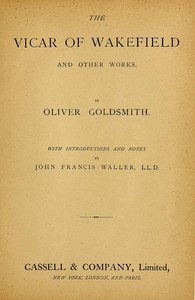
The Vicar of Wakefield — Reading Companion
(0 User reviews)
269
Project Gutenberg
2001
Not confirmed
England -- Fiction; Domestic fiction; Poor families -- Fiction; Clergy -- Fiction; Children of clergy -- Fiction; Prisoners -- Fiction; Abduction -- Fiction
Readers of public-domain and historical texts
Project Gutenberg digital edition
en
Edition facts
Words
67,597
Reading time
294 min
Text sections
34
The source record for The Vicar of Wakefield — Reading Companion measures this digital text at 67,597 words, 4 hr 54 min estimated reading time, and 34 detected text sections.
The text analysis averages about 26.0 words per sentence, while the detected sections provide another way to judge how the source is divided.
Project Gutenberg metadata also associates the work with “England -- Fiction,” connecting these edition facts with the source record’s subject description.
Source:
Project Gutenberg record #2667
Oliver Goldsmith's novel follows the misfortunes of the Primrose family through the vicar's first-person narration, using a structure of alternating domestic scenes and sudden reversals, with recurring images of imprisonment and rural simplicity.
Read the complete public-domain text at its original source.
Read on Project GutenbergThe Vicar of Wakefield opens with a family portrait that emphasizes likeness in both minds and persons, a structural cue that the Primrose household will function as a collective character. Goldsmith's narrator, Dr. Primrose, presents himself as a priest, husbandman, and father, a triple role that frames the novel's movement between domestic stability and external calamity. The tale is supposedly written by himself, a device that allows the vicar's voice to dominate even as events spiral beyond his control.
The work's structure relies on abrupt shifts: from country fireside to town wit, from fortune to loss. Recurring images of imprisonment—both literal, as in Newgate, and figurative, as in social constraint—appear early in the son's account of an usher's life, where he would rather be an under turnkey than a schoolteacher. These patterns of confinement and release shape the narrative's rhythm.
A Tale Told in Reversals
The novel's thirty-two chapters move through a series of sudden reversals that test the vicar's stoic philosophy. Chapter titles often promise one thing and deliver another: 'Fortune seems resolved to humble the family of Wakefield' is followed by 'Fresh mortifications, or a demonstration that seeming calamities may be real blessings.' This pattern of expectation and disappointment is built into the structure. The vicar's son George, for instance, recounts his attempt to become an author by writing three paradoxes—'false, indeed, but they were new'—only to be met with neglect. The learned world, he says, 'said nothing to my paradoxes; nothing at all, Sir.' Such deflations recur throughout, undercutting the characters' schemes and the reader's predictions.
The Vicar's Voice and Its Limits
Dr. Primrose narrates with a blend of moral certainty and self-deprecating humor. He is 'ready to teach, and ready to obey,' as the Advertisement puts it, but his perspective is not omniscient. The reader learns events only as he does, which creates dramatic irony when his judgments prove wrong. For example, he initially trusts Mr. Burchell, then denounces him as a villain, only to have that verdict reversed. The vicar's voice is consistent—formal, didactic, occasionally pompous—but the narrative structure forces him to confront his own fallibility. His son's story of the 'Sardonic grin' and the advice to avoid school reveals a world of experience the vicar himself lacks, hinting at limits to his authority.
Recurring Images of Confinement
Imprisonment appears both as literal setting and as metaphor. George's account of the usher's life compares it to being an 'under turnkey in Newgate,' and later the family faces actual incarceration. The vicar's own philosophy—that 'the poor' should not 'attempt to appear above their circumstances'—suggests a self-imposed confinement to social station. Yet the novel's movement repeatedly breaks these bounds: the family migrates, loses fortune, and encounters characters from different spheres. The image of the porcupine, 'self collected, with a quill pointed against every opposer,' used by George to describe his authorial stance, also reflects the defensive posture the family must adopt. These recurring motifs of enclosure and resistance give the narrative a cohesive visual language.
Movement Between Country and Town
The novel's geography shifts between the rural 'country fire-side' and the urban world of London and its coffee-houses. The vicar idealizes the former as a site of happiness that 'depends not on circumstance, but constitution,' but the plot repeatedly drags the family into the latter. George's journey to town to seek a career introduces a different register: the cynical advice of his cousin, the 'true Sardonic grin,' and the Grub-street world of hack writing. This contrast between pastoral simplicity and metropolitan complexity is not merely scenic; it drives the plot's reversals. The family's attempts to 'cope with their betters' or 'hold up their heads' in society lead to mortifications that the country setting could not produce. The structure thus alternates between these poles, using each to critique the other.
Readers attentive to the novel's architecture will notice how Goldsmith uses the vicar's limited viewpoint to create suspense and irony. The chapter titles, often moralizing or paradoxical, serve as unreliable guides to what follows. Pay particular attention to the moments when the vicar's certainties are overturned—these are the hinges of the plot. The recurring imagery of prisons, both literal and metaphorical, rewards close tracking across the narrative.
Reading The Vicar of Wakefield, I kept thinking how the Primrose family’s quiet little routines—their meals, their walks—held them together through every reversal. That same steady warmth lives in Home Scenes and Home Influence; a series of tales and sketches — Background and Themes. It’s strange, isn’t it, how the smallest domestic details become the most lasting comforts when everything else falls away.
There are no reviews for this eBook.
There are no comments for this eBook.
Reader reflection
How will you remember this book?
Save your reaction, strongest insight, and memorable passage.
Your progress
0
/
10
2
Did this book hold your interest?
3
Is this a title you would suggest to others?
4
How demanding did the text feel?
5
What did you appreciate most?
6
Would you start a conversation about this book?
7
How did the reading compare with what you expected?
8
How would you rate its originality?
9
Which lesson or insight stayed with you?
10