
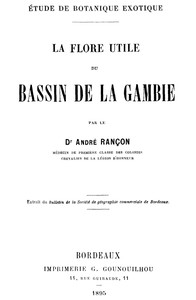
La flore utile du bassin de la Gambie by A. Rançon
Read "La flore utile du bassin de la Gambie by A. Rançon" Online
This book is available in the public domain. Start reading the digital edition below.
START READING FULL BOOKBook Preview
A short preview of the book’s content is shown below to give you an idea of its style and themes.
Forget novels for a moment. This book is a time capsule and a field guide rolled into one. Published in 1894, it’s the result of André Rançon’s work as part of a French scientific mission in The Gambia. His job wasn't to write a dramatic tale, but to systematically record a way of life. He cataloged hundreds of plants, but he didn't just list their Latin names. He documented exactly how the local Wolof, Serer, and other communities used them. Which root treated a fever, which tree provided the best timber for canoes, which fruit could be eaten in the dry season. It’s a detailed snapshot of indigenous knowledge, captured by an outsider during the colonial era.
Why You Should Read It
This book surprised me. I expected a dry scientific catalog, but it’s strangely gripping. You start seeing the landscape through the eyes of someone who depended on it completely. Rançon’s notes reveal a deep, practical intelligence in how people lived in harmony with their environment. It makes you think about where our own food and medicine come from. There’s also a quiet tension throughout—you’re aware this knowledge was being collected by a colonial power, which adds a complex layer to the reading. It’s less about Rançon himself and more about the people whose wisdom he recorded.
Final Verdict
Perfect for history buffs, gardeners with a curious mind, or anyone fascinated by ethnobotany and survival skills. It’s not a page-turning thriller, but a slow, rewarding read for when you want to learn something truly unique. Think of it as an antique manual for a world that has largely vanished, written with the careful eye of a scientist who understood he was documenting something precious.
You are viewing a work that belongs to the global public domain. You can copy, modify, and distribute it freely.
Emily Clark
4 months agoA must-have for anyone studying this subject.
Brian Smith
1 year agoThis is one of those stories where the character development leaves a lasting impact. One of the best books I've read this year.
Emma Perez
6 months agoCompatible with my e-reader, thanks.
Anthony Williams
8 months agoI was skeptical at first, but the diagrams and footnotes included in this version are very helpful. I will be reading more from this author.
Lisa Flores
6 months agoRecommended.