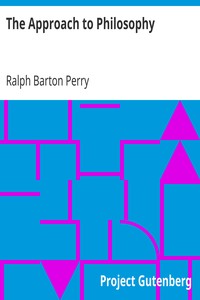
The Approach to Philosophy by Ralph Barton Perry

(5 User reviews)   942
By Jason Bauer Posted on Jan 12, 2026
In Category - Wit & Irony
Perry, Ralph Barton, 1876-1957 Perry, Ralph Barton, 1876-1957
English
Ever wondered what philosophy actually is? Not just the big names like Plato and Kant, but the whole messy, wonderful project of human thinking? Ralph Barton Perry's 'The Approach to Philosophy' is like a friendly guide who meets you at the door. Forget dense textbooks. Perry invites you in, shows you around the different rooms of thought—metaphysics, ethics, logic—and explains why people keep coming back to these ancient questions. It's not about giving you all the answers. It's about handing you a map and a flashlight, showing you how the search for wisdom begins. If you've ever felt curious but intimidated, this is your perfect starting point.
Share

Read "The Approach to Philosophy by Ralph Barton Perry" Online

This book is available in the public domain. Start reading the digital edition below.

START READING FULL BOOK
Instant Access    Mobile Friendly

Book Preview

A short preview of the book’s content is shown below to give you an idea of its style and themes.

various great human interests have been selected as points of departure. I have sought to introduce the general stand-point and problem of philosophy through its implication in practical life, poetry, religion, and science. But in so doing it has been necessary for me to deal shortly with topics of great independent importance, and so risk the disfavor of those better skilled in these several matters. This is evidently true of the chapter which deals with natural science. But the problem which I there faced differed radically from those of the foregoing chapters, and the method of treatment is correspondingly different. In the case of natural science one has to deal with a body of knowledge which is frequently regarded as the only knowledge. To write a chapter about science from a philosophical stand-point is, in the present state of opinion, to undertake a polemic against exclusive naturalism, an attitude which is itself philosophical, and as such is well known in the history of philosophy as _positivism_ or _agnosticism_. I have avoided the polemical spirit and method so far as possible, but have, nevertheless, here taken sides against a definite philosophical position. This chapter, together with the Conclusion, is therefore an exception to the purely introductory and expository representation which I have, on the whole, sought to give. The relatively great space accorded to the discussion of religion is, in my own belief, fair to the general interest in this topic, and to the intrinsic significance of its relation to philosophy. I have in Part II undertaken to furnish the reader with a map of the country to which he has been led. To this end I have attempted a brief survey of the entire programme of philosophy. An accurate and full account of philosophical terms can be found in such books as Külpe's "Introduction to Philosophy" and Baldwin's "Dictionary of Philosophy," and an attempt to emulate their thoroughness would be superfluous, even if it were conformable to the general spirit of this book. The scope of Part II is due in part to a desire for brevity, but chiefly to the hope of furnishing an epitome that shall follow the course of the _natural and historical differentiation_ of the general philosophical problem. Finally, I have in Part III sought to present the tradition of philosophy in the form of general types. My purpose in undertaking so difficult a task is to acquaint the reader with philosophy in the concrete; to show how certain underlying principles may determine the whole circle of philosophical ideas, and give them unity and distinctive flavor. Part II offers a general classification of philosophical problems and conceptions independently of any special point of view. But I have in Part III sought to emphasize the point of view, or the internal consistency that makes a _system of philosophy_ out of certain answers to the special problems of philosophy. In such a division into types, lines are of necessity drawn too sharply. There will be many historical philosophies that refuse to fit, and many possibilities unprovided for. I must leave it to the individual reader to overcome this abstractness through his own reflection upon the intermediate and variant stand-points. Although the order is on the whole that of progressive complexity, I have sought to treat each chapter with independence enough to make it possible for it to be read separately; and I have provided a carefully selected bibliography in the hope that this book may serve as a stimulus and guide to the reading of other books. The earlier chapters have already appeared as articles: Chapter I in...

This is a limited preview. Download the book to read the full content.

This isn't a storybook with a plot, but think of it as an adventure map for your mind. In The Approach to Philosophy, Ralph Barton Perry doesn't lecture you on what philosophers said. Instead, he walks you through the fundamental questions that make someone a philosopher in the first place. He explores the big areas: What is real (metaphysics)? How do we know what we know (epistemology)? What is good (ethics)? He shows how these questions aren't academic exercises—they grow from our everyday confusion and wonder about the world.

Why You Should Read It

I loved this book because it treats you like an intelligent friend, not a student. Perry has a gift for clearing away the jargon. He makes you see philosophy as a natural human activity, something we all do when we puzzle over right and wrong or the nature of truth. Reading it feels like getting a clear, calm briefing before embarking on a big journey. It builds your confidence. You finish it thinking, 'Okay, I can navigate this territory. I understand what the conversation is about.'

Final Verdict

This book is perfect for the curious beginner who's always wanted to explore philosophy but didn't know where to start. It's also great for anyone who had a bad experience with a dry philosophy class and needs a refresher on why it matters. If you're looking for deep analysis of specific thinkers, you'll need another book. But if you want a welcoming, insightful guide to the whole landscape of philosophical thought, Perry's approach is still one of the best introductions out there.


🔖 Public Domain Content

The copyright for this book has expired, making it public property. Use this text in your own projects freely.

Steven Adams
2 months ago

I was pleasantly surprised because the interplay between the protagonists drives the story forward beautifully. This felt rewarding to read.

Jessica Roberts
2 weeks ago

I approached this with curiosity because it creates a vivid world that you simply do not want to leave. An impressive piece of work.

Linda Lee
2 weeks ago

After finishing this book, the content remains relevant throughout without filler. A perfect companion for a quiet weekend.
George Moore
4 months ago

Based on the reviews, I decided to try it and the organization of topics is intuitive and reader-friendly. An unexpectedly enjoyable experience.

Elijah Flores
3 days ago

I downloaded this out of curiosity and the material feels polished and professionally edited. I finished this feeling genuinely satisfied.

4.5
4.5 out of 5 (5 User reviews )

Add a Review

Your Rating *
There are no comments for this eBook.
You must log in to post a comment.
Log in

Related eBooks