1

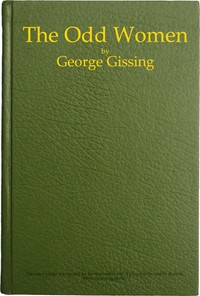
The Odd Women — Edition Insights
(0 User reviews)
409
Project Gutenberg
2003
Not confirmed
London (England) -- Fiction; Psychological fiction; Sisters -- Fiction; Single women -- Fiction; Domestic fiction; English fiction -- 19th century; Women -- England -- Fiction; Women -- Employment -- Fiction; Middle class women -- Fiction
Readers of public-domain and historical texts
Project Gutenberg digital edition
en
Edition facts
Words
145,280
Reading time
632 min
Text sections
33
The source record for The Odd Women — Edition Insights measures this digital text at 145,280 words, 10 hr 32 min estimated reading time, and 33 detected text sections.
The text analysis averages about 13.8 words per sentence, while the detected sections provide another way to judge how the source is divided.
Project Gutenberg metadata also associates the work with “London (England) -- Fiction,” connecting these edition facts with the source record’s subject description.
Source:
Project Gutenberg record #4313
George Gissing's 1893 novel examines the lives of single women in Victorian London through precise diction, dialogue, and description, focusing on the Madden sisters and their struggles with employment, marriage, and independence.
Read the complete public-domain text at its original source.
Read on Project GutenbergGeorge Gissing opens The Odd Women with a seemingly mundane conversation between Dr. Madden and his eldest daughter Alice about a life insurance policy. This domestic scene, set on the coast-downs by Clevedon in 1872, immediately establishes the novel's preoccupation with financial insecurity and the limited prospects for women. Dr. Madden's remark that 'girls ought not to be troubled about this kind of thing' reveals a paternalistic attitude that will be tested as the story unfolds. Gissing's diction is precise and unsparing: Alice is described as 'plain, shy, gentle-mannered,' and 'in movement something less than graceful,' signaling that this is a world where women are judged by their appearance and marriageability.
Diction and the Weight of Words
Gissing's choice of words often carries a double edge, revealing character and social critique simultaneously. When Dr. Madden speaks of his daughters, he uses the phrase 'the needs of his large family left him scarce a margin over expenditure,' a clinical, almost businesslike formulation that contrasts with his professed affection. Later, Monica's husband Edmund Widdowson responds to a social invitation with the dry remark, 'There is not much harm in it,' a phrase that betrays his suspicion of pleasure and his controlling nature. Gissing frequently deploys such understatement to expose the emotional repression and economic anxieties that shape his characters' interactions.
Dialogue as Social Performance
The dialogue in the excerpts reveals how characters use speech to negotiate status and desire. Mr. Bevis's self-deprecating banter—'How I ever undertake the thing I really don’t know'—is a calculated performance of charm, complete with exaggerated claims of emaciation and a 'specially made' office chair. Monica's responses are measured, her 'sad negative' when asked about playing piano hinting at her limited education. Gissing captures the rhythm of polite conversation, where true feelings are masked: Monica 'suppressed a laugh' while examining her husband, and Widdowson's approval of Bevis is grudging ('he isn’t a bad fellow'). These exchanges are not mere filler; they advance the novel's exploration of how women must perform agreeableness to secure their place.
Description and the Gendered Gaze
Gissing's descriptive passages often focalize through a character's perspective, embedding judgment in physical detail. Alice Madden is seen through her father's eyes as 'plain' and 'short of stature,' while Monica is observed by Bevis with 'fair, comely face.' The narrator's own voice, however, is more detached: Dr. Madden is 'grave but benign, amiably diffident, with a hint of lurking mirthfulness.' This layered description allows Gissing to critique societal standards without overt commentary. The setting itself—the 'coast-downs by Clevedon,' the 'blue channel to the Welsh hills'—serves as a backdrop to economic realities, a pastoral scene undercut by the talk of insurance and precarious livelihoods.
Recurring Motifs: Money and Marriage
Throughout the excerpts, money and marriage are intertwined in characters' thoughts and speech. Dr. Madden's life insurance is meant to protect his daughters, yet his death leaves them vulnerable—a fact the novel will explore. Monica's marriage to Widdowson is shadowed by financial calculation: she contrasts his disapproval of Mr. Barfoot with his grudging acceptance of Bevis, who is 'not a bad fellow' but also a potential threat. Gissing uses the motif of 'the fold and the shepherd' from the first chapter title to suggest both religious comfort and the confinement of women within domestic roles. The 'odd women' of the title—those who remain unmarried—are a statistical reality that the novel confronts through these recurring concerns.
Readers attentive to Gissing's craft will notice how he builds meaning through small, precise details: a father's apologetic tone, a husband's dry retort, a woman's suppressed laugh. The novel does not offer easy resolutions but instead invites scrutiny of the social structures that shape its characters' lives. Pay particular attention to the gaps between what characters say and what the narration reveals—these silences are where Gissing's critique of Victorian gender norms is most potent.
The rain kept time with Gissing’s precise sentences that afternoon, and I found myself thinking about how his women carried their solitude—sturdy, unromantic, almost architectural. Later, half-awake, that weight led me elsewhere, to a quieter, denser kind of intimacy. The fog outside softened, and I reached for The Golden Bowl — Volume 2 — Context and Discussion, where another kind of waiting begins.
There are no reviews for this eBook.
There are no comments for this eBook.
Reader reflection
Your personal reading reflection
Build a private reading journal entry for this title.
Your progress
0
/
10
2
Did this book hold your interest?
3
Is this a title you would suggest to others?
4
Did the language feel accessible?
5
Which aspect of the book did you value most?
6
Could you see yourself revisiting this book?
7
Did it raise ideas you would like to talk about?
8
Did any part of the book stay with you emotionally?
9
What changed or sharpened your thinking?
10