1

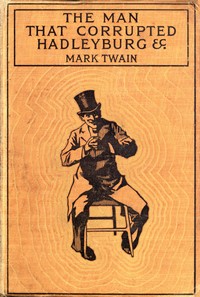
The Man That Corrupted Hadleyburg, and Other Stories — Inside the Classic
(0 User reviews)
165
Project Gutenberg
2004
Not confirmed
Short stories; Humorous stories, American; City and town life -- Fiction; Honesty -- Fiction; United States -- Social life and customs -- 19th century -- Fiction
Readers of public-domain and historical texts
Project Gutenberg digital edition
en
Edition facts
Words
128,732
Reading time
560 min
Text sections
28
This digital edition of The Man That Corrupted Hadleyburg, and Other Stories — Inside the Classic is described by source-level measurements including 128,732 words, 9 hr 20 min estimated reading time, and 28 detected text sections.
The text analysis averages about 18.4 words per sentence, while the detected sections provide another way to judge how the source is divided.
Project Gutenberg metadata also associates the work with “Short stories,” connecting these edition facts with the source record’s subject description.
Source:
Project Gutenberg record #3251
This collection of Mark Twain's later short fiction and essays includes the title story's elaborate revenge plot against a self-righteous town, alongside pieces on Christian Science, Jewish history, and personal anecdotes, revealing a satirist probing moral complacency and social hypocrisy.
Read the complete public-domain text at its original source.
Read on Project GutenbergThe title story, “The Man That Corrupted Hadleyburg,” opens with a town so proud of its incorruptible reputation that it teaches honesty “to its babies in the cradle.” The narrator immediately undercuts this pride by noting that neighboring towns “affected to sneer at Hadleyburg’s pride in it and call it vanity.” The revenge plot that follows is set in motion by a stranger who feels offended—possibly without the town’s knowledge—and spends a year devising a plan that will “comprehend the entire town.” The story’s elaborate trap, involving a mysterious sack of money and a letter, tests the very honesty the town boasts of.
A Town’s Honesty Put to the Test
The opening paragraphs of the title story establish Hadleyburg as a place where honesty is not just a virtue but a manufactured product. The town’s methods—teaching principles “in the cradle,” keeping temptations away from the young—suggest a controlled environment rather than genuine moral strength. The stranger’s revenge is designed to exploit this artificiality: he creates a situation where the town’s leading citizens must choose between public honor and private gain. The excerpt shows the stranger’s careful planning, but the full outcome is not revealed in the provided text. What is clear is that Twain uses the setup to question whether honesty that has never been tested can be trusted.
Satire Beyond the Title Story
The collection includes pieces that extend Twain’s satirical gaze to other targets. In “Concerning the Jews,” the narrator offers a historical and economic analysis of anti-Semitism, arguing that religious prejudice alone cannot account for persecution: “Protestants have persecuted Catholics, but they did not take their livelihoods away from them.” The essay traces restrictions on Jewish trades across centuries, noting that “ages of restriction to the one tool which the law was not able to take from him—his brain—have made that tool singularly competent.” This piece, while non-fiction, shares with the title story a focus on how communities and systems shape—or distort—individual behavior.
Structure and Variety in the Collection
The table of contents reveals a mix of genres: short stories, essays, a play excerpt (“Meisterschaft”), and personal reminiscences (“My Boyhood Dreams”). Pieces like “My First Lie, and How I Got Out of It” and “The Esquimaux Maiden’s Romance” suggest Twain’s characteristic first-person narrative voice, while “Christian Science and the Book of Mrs. Eddy” indicates a direct engagement with contemporary religious movements. The variety means that readers encounter different modes of Twain’s writing—from the tightly plotted revenge narrative of the title piece to the discursive, argumentative style of the essays. The collection does not present a unified theme so much as a showcase of Twain’s later interests and techniques.
Readers approaching this collection should be prepared for shifts in tone and form. The title story rewards attention to its careful construction, while the essays demand engagement with Twain’s opinions on topics like religion and economics. The excerpts do not reveal how the revenge plot concludes or how the other stories develop, so judgment on the collection’s overall arc must be withheld. What is evident is that Twain remains a sharp observer of human weakness, whether in a small town or in broader historical patterns.
Reading Twain's later work, I keep thinking how he peels back the shine of moral certainty, leaving something rawer underneath. That same quiet ache for honesty—without easy answers—lingers in the wilderness of his other book, In the Wilderness — Context and Discussion. It feels less like a study, more like an old friend's sigh over what we pretend to know.
There are no reviews for this eBook.
There are no comments for this eBook.
Reader reflection
Take a moment to reflect on this book
Create a short personal record of your experience with this book.
Your progress
0
/
10
2
Did this book hold your interest?
3
Would you recommend this book to another reader?
4
How much effort did this book require?
5
How much did the book move you?
6
Was the book easy to understand?
7
How would you rate its originality?
8
Would you start a conversation about this book?
9
What is the main idea you are taking away?
10