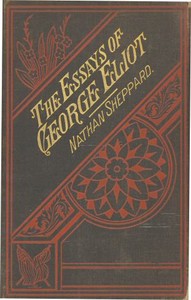
The Essays of "George Eliot" by George Eliot

(4 User reviews)   382
By Jason Bauer Posted on Jan 12, 2026
In Category - Classic Humor
Eliot, George, 1819-1880 Eliot, George, 1819-1880
English
Forget everything you think you know about Victorian essays. George Eliot's collection isn't dusty philosophy—it's a series of quiet, brilliant conversations with one of the sharpest minds of the 19th century. She writes about art, morality, and daily life with such clarity and warmth that you feel she's sitting across from you. The 'conflict' here isn't a plot, but the struggle to live thoughtfully in a complicated world. If you've ever wished for a wiser, kinder friend to help you untangle modern problems, this book is that friend, speaking directly to you from over a century ago.
Share

Read "The Essays of "George Eliot" by George Eliot" Online

This book is available in the public domain. Start reading the digital edition below.

START READING FULL BOOK
Instant Access    Mobile Friendly

Book Preview

A short preview of the book’s content is shown below to give you an idea of its style and themes.

In the Office of the Librarian of Congress at Washington, D. C. CONTENTS. PREFACE, 5 “GEORGE ELIOT’S” ANALYSIS OF MOTIVES, 7 I.—CARLYLE’S LIFE OF STERLING, 25 II.—WOMAN IN FRANCE, 31 III.—EVANGELICAL TEACHING, 64 IV.—GERMAN WIT, 99 V.—NATURAL HISTORY OF GERMAN LIFE, 141 VI.—SILLY NOVELS BY LADY NOVELISTS, 178 VII.—WORLDLINESS AND OTHER-WORLDLINESS, 205 VIII.—THE INFLUENCE OF RATIONALISM, 257 IX.—THE GRAMMAR OF ORNAMENT, 272 X.—FELIX HOLT’S ADDRESS TO WORKINGMEN, 275 PREFACE. Since the death of George Eliot much public curiosity has been excited by the repeated allusions to, and quotations from, her contributions to periodical literature, and a leading newspaper gives expression to a general wish when it says that “this series of striking essays ought to be collected and reprinted, both because of substantive worth and because of the light they throw on the author’s literary canons and predilections.” In fact, the articles which were published anonymously in _The Westminster Review_ have been so pointedly designated by the editor, and the biographical sketch in the “Famous Women” series is so emphatic in its praise of them, and so copious in its extracts from one and the least important one of them, that the publication of all the Review and magazine articles of the renowned novelist, without abridgment or alteration, would seem but an act of fair play to her fame, while at the same time a compliance with a reasonable public demand. Nor are these first steps in her wonderful intellectual progress any the less, but are all the more noteworthy, for being first steps. “To ignore this stage,” says the author of the valuable little volume to which we have just referred—“to ignore this stage in George Eliot’s mental development would be to lose one of the connecting links in her history.” Furthermore, “nothing in her fictions excels the style of these papers.” Here is all her “epigrammatic felicity,” and an irony not surpassed by Heine himself, while her paper on the poet Young is one of her wittiest bits of critical analysis. Her translation of Status’s “Life of Jesus” was published in 1840, and her translation of Feuerbach’s “Essence of Christianity” in 1854. Her translation of Spinoza’s “Ethics” was finished the same year, but remains unpublished. She was associate editor of _The Westminster Review_ from 1851 to 1853. She was about twenty-seven years of age when her first translation appeared, thirty-three when the first of these magazine articles appeared, thirty-eight at the publication of her first story, and fifty-nine when she finished “Theophrastus Such.” Two years after she died, at the age of sixty-one. So that George Eliot’s literary life covered a period of about thirty-two years. The introductory chapter on her “Analysis of Motives” first appeared as a magazine article, and appears here at the request of the publishers, after having been carefully revised, indeed almost entirely rewritten by its author. “GEORGE ELIOT’S” ANALYSIS OF MOTIVES. George Eliot is the greatest of the novelists in the delineation of feeling and the analysis of motives. In “uncovering certain human lots, and seeing how they are woven and interwoven,” some marvellous work has been done by this master in the two arts of rhetoric and fiction. If you say the telling of a story is her forte, you put her below Wilkie Collins or Mrs. Oliphant; if you say her object is to give a picture of English society, she is surpassed by Bulwer and Trollope; if she be called a satirist of society, Thackeray is her superior; if she intends to illustrate the absurdity of behavior, she is eclipsed by Dickens; but if the analysis of human motives be...

This is a limited preview. Download the book to read the full content.

The Story

This isn't a book with a plot in the usual sense. It's a collection of George Eliot's non-fiction pieces, written mostly before she became famous for novels like Middlemarch. Think of it as a guided tour through her brilliant mind. She writes about everything from the purpose of art and the silly trends of her day, to deep questions about how we should live and treat each other. Each essay is a self-contained exploration, full of her signature intelligence and deep human sympathy.

Why You Should Read It

I picked this up expecting historical curiosity and found a shockingly modern voice. Eliot's observations on society, ethics, and the slow work of personal growth feel like they were written yesterday. Her writing has this incredible balance—it's intellectually rigorous but never cold, deeply moral but never preachy. You get the sense of a person thinking in real time, working out big ideas with honesty and care. It made me slow down and think about my own views in a new way.

Final Verdict

This is for the thoughtful reader. Perfect for anyone who loves ideas, enjoys a beautifully crafted sentence, or wants to connect with a truly great mind. It's not a page-turner in the thriller sense, but it's profoundly engaging. If you like authors like Rebecca Solnit or Oliver Sacks, who blend insight with clear, compassionate prose, you'll find a kindred spirit in George Eliot. Keep it on your nightstand and read an essay at a time—it's a book to savor.


⚖️ Open Access

This work has been identified as being free of known copyright restrictions. Share knowledge freely with the world.

Christopher Harris
2 months ago

Out of sheer curiosity, the logical flow of arguments makes it an essential resource for research. Well worth recommending.

Steven Sanchez
3 months ago

I usually don’t leave feedback, but the content remains relevant throughout without filler. I’ll definitely revisit this in the future.

Emily Young
2 months ago

I’ve been searching for content like this and the author's voice is distinct, making the complex topics easy to digest. I will be reading more from this author.

Betty Smith
4 months ago

After spending time with this material, the balance between theory and practice is exceptionally well done. This left a lasting impression on me.

4.5
4.5 out of 5 (4 User reviews )

Add a Review

Your Rating *
There are no comments for this eBook.
You must log in to post a comment.
Log in

Related eBooks