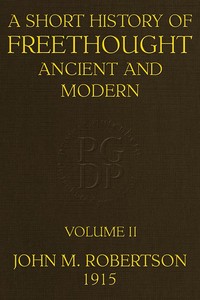
A Short History of Freethought Ancient and Modern, Volume 2 of 2 by J. M. Robertson

(4 User reviews)   824
By Jason Bauer Posted on Jan 12, 2026
In Category - Comedy Writing
Robertson, J. M. (John Mackinnon), 1856-1933 Robertson, J. M. (John Mackinnon), 1856-1933
English
Ever wonder how people managed to think for themselves before the internet? This book is like a detective story about ideas. Robertson tracks the dangerous, often hidden history of people who questioned everything—from ancient philosophers who risked exile to Renaissance writers who flirted with execution. It’s not about famous battles or kings, but the quieter, more personal fight to use your own brain in a world that often tells you not to. If you’ve ever felt that itch to question why things are the way they are, this book shows you’re part of a much longer, braver tradition than you might think.
Share

Read "A Short History of Freethought Ancient and Modern, Volume 2 of 2 by J. M. Robertson" Online

This book is available in the public domain. Start reading the digital edition below.

START READING FULL BOOK
Instant Access    Mobile Friendly

Book Preview

A short preview of the book’s content is shown below to give you an idea of its style and themes.

§ 5. Popular Thought in Europe. Callidius. Flade. Wier. Coornhert. Grotius. Gorlæus. Zwicker. Koerbagh. Beverland. Socinianism. The case of Spain. Cervantes 32 § 6. Scientific Thought. Copernicus. Giordano Bruno. Vanini. Galileo. The Aristotelian strife. Vives. Ramus. Descartes. Gassendi 41 Chap. XIV--British Freethought in the Seventeenth Century § 1. Lord Herbert of Cherbury. Hobbes. Selden 69 § 2. The popular ferment: attempted suppression of heresy by Parliament. Lawrence Clarkson. The Levellers and Toleration. Forms of unbelief. The term "rationalist." Propaganda against atheism. Culverwel. The Polemic of Henry More. Freethought at the Restoration. The case of Biddle. The protests of Howe, Stillingfleet, and Baxter. Freethought in Scotland. The argument of Mackenzie. English Apologetics of Casaubon, Ingelo, Temple, Wilkins, Tillotson, Cudworth, Boyle, and others. Martin Clifford. Emergence of Deism. Avowals of Archdeacon Parker, Sherlock, and South. Dryden. Discussion on miracles. Charles Blount. Leslie's polemic. Growth of apologetic literature. Toland. The Licensing Act 75 § 3. Literary, scientific, and academic developments. Sir Thomas Browne. Jeremy Taylor. John Spencer. Joseph Glanvill. Cartesianism. Glisson. Influence of Gassendi. Resistance to Copernican theory. Lord Falkland. Colonel Fry. Locke. Bury. Temple. The Marquis of Halifax. Newton. Unitarianism. Penn. Firmin. Latitudinarianism. Tillotson. Dr. T. Burnet. Dr. B. Connor. John Craig. The "rationalists" 100 Chap. XV--French and Dutch Freethought in the Seventeenth Century 1. Influence of Montaigne and Charron. Gui Patin. Naudé. La Mothe le Vayer 117 2. Catholic Pyrrhonism 120 3. Descartes's influence. Boileau. Jesuit and royal hostility 121 4. Vogue of freethinking. Malherbe. Joan Fontanier. Théophile de Viau. Claude Petit. Corneille. Molière 122 5. Cyrano de Bergerac 123 6. Pascal's skepticism. Religious quarrels 124 7. Huet's skepticism 126 8. Cartesianism. Malebranche 128 9. Buffier. Scientific movements 130 10. Richard Simon. La Peyrère 131 11. Dutch thought. Louis Meyer. Cartesian heresy 132 12. Spinoza 133 13. Biblical criticism. Spinozism. Deurhoff. B. Bekker 137 14. Bayle 139 15. Developments in France. The polemic of Abbadie. Persecution of Protestants. Fontenelle 141 16. St. Evremond. Regnard. La Bruyère. Spread of skepticism. Fanaticism at court 143 Chap. XVI--British Freethought in the Eighteenth Century § 1. Toland. Blasphemy Law. Strifes among believers. Cudworth. Bishops Browne and Berkeley. Heresy in the Church. The Schools of Newton, Leibnitz, and Clarke. Hutchinson. Halley. Provincial deism. Saunderson. Simson. Literary orthodoxy. Addison. Steele. Berkeley. Swift. New deism. Shaftesbury. Trenchard. Unitarianism. Asgill. Coward. Dodwell. Whiston 147 § 2. Anthony Collins. Bentley's attack. Mandeville. Woolston. Middleton. Deism at Oxford. Tindal. Middleton and Waterland 154 § 3. Unitarianism: its spread among Presbyterians. Chubb. Hall. Elwall 159 § 4. Berkeley's polemic. Lady Mary Montagu. Pope. Deism and Atheism. Coward. Strutt 162 § 5. Parvish. Influence of Spinoza 167 § 6. William Pitt. Morgan. Annet. Dodwell the Younger 169 § 7. The work achieved by deism. The social situation. Recent disparagements and German testimony 170 § 8. Arrest of English science. Hale. Burnet. Whiston. Woodward. Effects of Imperialism. Contrast with France. The mathematicians 176 § 9. Supposed "decay" of deism. Butler. William Law. Hume 179 § 10. Freethought in Scotland. Execution of Thomas Aikenhead. Confiscation of innovating books. Legislation against deism. Anstruther's and Halyburton's polemic. Strife over creeds. John Johnstone. William Dudgeon. Hutcheson. Leechman. Forbes. Miller. Kames. Smith. Ferguson. Church riots 181 § 11. Freethought in Ireland. Lord Molesworth. Archbishop Synge. Bishop Clayton 188 § 12. Situation in England in 1750. Richardson's lament. Middleton. Deism among the clergy. Sykes. The deistic evolution 190 § 13. Materialism. La Mettrie. Shifting of the social centre: socio-political forces. Gray's avowal. Hume's estimate. Goldsmith's. The later deism. Bolingbroke 194 § 14. Diderot's diagnosis. Influence of Voltaire. Chatterton. Low state of popular culture. Prosecutions of poor freethinkers. Jacob Ilive. Peter...

This is a limited preview. Download the book to read the full content.

This isn't a novel with a plot, but the story it tells is gripping. Volume 2 picks up after the Middle Ages, following the thread of skeptical and independent thought through the Renaissance, the Scientific Revolution, and into the 18th and 19th centuries. Robertson shows us how ideas we take for granted today—like religious tolerance or relying on evidence—were hard-won by people who often faced serious backlash. He connects dots between thinkers across Europe, showing how a radical idea in France might inspire a publisher in England or a philosopher in Germany.

Why You Should Read It

What grabbed me was how personal it felt. Robertson isn't just listing names and dates. He's showing the human cost and courage behind intellectual freedom. You get a real sense of the tension these writers and scientists lived with. They weren't always heroes; some were cautious, some wrote anonymously, but they kept the conversation alive. It makes you appreciate the books on your shelf in a whole new way. Reading this in the 21st century, it’s a powerful reminder that the freedom to debate and doubt is a fragile achievement, not a given.

Final Verdict

Perfect for curious readers who enjoy history but want to look behind the curtain of major events. It’s for anyone who’s asked, "But why do we believe that?" This book provides a fascinating, character-driven answer. Be prepared—it’s dense and detailed, so it's best taken in chunks. But if you stick with it, you'll come away with a deeper understanding of the long, complicated, and deeply human struggle for the right to think freely.


🏛️ Copyright Free

This content is free to share and distribute. You do not need permission to reproduce this work.

Richard Robinson
1 week ago

Honestly, the emotional weight of the story is balanced perfectly with moments of levity. This left a lasting impression on me.

Joshua Williams
2 months ago

I went into this with no expectations and the arguments are well-supported by credible references. An unexpectedly enjoyable experience.

Nancy Hall
3 months ago

I found this while browsing online and the emotioonal weight of the story is balanced perfectly with moments of levity. A perfect companion for a quiet weekend.

Steven Johnson
5 months ago

In my opinion, the structure allows easy navigation and quick referencing. I have no regrets downloading this.

4.5
4.5 out of 5 (4 User reviews )

Add a Review

Your Rating *
There are no comments for this eBook.
You must log in to post a comment.
Log in

Related eBooks