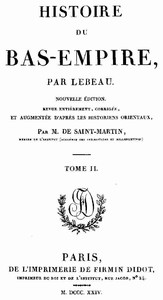
Histoire du Bas-Empire. Tome 02 by Charles Le Beau

(4 User reviews)   775
By Jason Bauer Posted on Jan 12, 2026
In Category - Comedy Writing
Le Beau, Charles, 1701-1778 Le Beau, Charles, 1701-1778
French
Okay, so you think the fall of Rome was just about barbarians and a sacked city? Think again. Charles Le Beau's second volume takes us deep into the messy, fascinating centuries *after* the Western Empire officially collapsed. This is the story of the 'ghost' of Rome—how its laws, culture, and even its title of 'Emperor' refused to die, haunting the new kingdoms rising from its ashes. It’s a gripping look at how an ending isn't really an ending, but a chaotic and often violent transformation. If you love the drama of power vacuums, unlikely survivors, and the long shadow of a fallen giant, this is your next read.
Share

Read "Histoire du Bas-Empire. Tome 02 by Charles Le Beau" Online

This book is available in the public domain. Start reading the digital edition below.

START READING FULL BOOK
Instant Access    Mobile Friendly

Book Preview

A short preview of the book’s content is shown below to give you an idea of its style and themes.

MEMBRE DE L'INSTITUT (ACADÉMIE DES INSCRIPTIONS ET BELLES-LETTRES). TOME II. PARIS, DE L'IMPRIMERIE DE FIRMIN DIDOT, IMPRIMEUR DU ROI ET DE L'INSTITUT, RUE JACOB, Nº 24. M. DCCC. XXIV. HISTOIRE DU BAS-EMPIRE. LIVRE VII. I. État de l'empire. II. Caractère de Constant. III. Ministres de Constant. IV. Quel jugement on peut porter de ce prince. V. Caractère de Magnence. VI. Il est proclamé Auguste. VII. Mort de Constant. VIII. Suites de la révolte de Magnence. IX. Vétranion prend le titre d'Auguste. X. Entreprise de Népotianus. XI. Tyrannie de Magnence. XII. Guerre de Perse. XIII. Siége de Nisibe. XIV. Commencement du siége. XV. Sapor inonde la ville. XVI. Nouvelle attaque. XVII. Opiniâtreté de Sapor. XVIII. Levée du siége. XIX. Miracles qu'on raconte à l'occasion de ce siége. XX. Préparatifs de Constance. XXI. Députation de Magnence. XXII. Vétranion dépouillé. XXIII. Conduite de Constance à l'égard de Vétranion. XXIV. Constance jette les yeux sur Gallus pour le faire César. XXV. Éducation de Gallus et de Julien. XXVI. Gallus et Julien à Macellum. XXVII. Différent succès des instructions chrétiennes données aux deux princes. XXVIII. Gallus déclaré César. XXIX. Il purifie le bourg de Daphné. XXX. Décentius César. XXXI. Magnence se met en marche. XXXII. Propositions de paix rejetées par Magnence. XXXIII. Il reçoit un échec au passage de la Save. XXXIV. Insolence de Titianus. XXXV. Divers succès de Magnence. XXXVI. Bataille de Mursa. XXXVII. Perte de part et d'autre. XXXVIII. Ruse de Valens. XXXIX. Suites de la bataille. XL. Magnence se retire en Italie. XLI. Il fuit dans les Gaules. XLII. Embarras de Magnence. XLIII. Il attente à la vie de Gallus. XLIV. Mort de Magnence. XLV. Lois touchant la religion. XLVI. Lois concernant l'ordre civil. XLVII. Lois militaires. CONSTANCE, CONSTANT. [Note latérale: AN 349. I. Etat de l'empire. Soz. l. 3, c. 18. Cod. Th. Lib. 16, tit. 10. leg. 2, 3. et ibi God.] L'empire, gouverné depuis douze ans par des princes fort inférieurs en mérite à Constantin, perdait peu à peu son éclat, sans avoir encore rien perdu de ses forces. Constance, réglé dans ses mœurs, mais sombre et bizarre, s'égarait dans des discussions théologiques, où l'hérésie pratiquait mille détours. Obsédé par des évêques ariens et toujours environné de conciles, il négligeait la gloire de l'état, et n'opposait qu'une faible résistance aux fréquentes incursions des Perses. Constant, plus livré aux plaisirs, tranquille du côté de ses frontières, dont il avait écarté les Francs, s'en rapportait sur les questions de doctrine à Maximin, évêque de Trèves, dont il connaissait la sainteté éminente et la science consommée. Guidé par les sages conseils de ce prélat, il se déclarait hautement le défenseur de l'orthodoxie; il réprimait l'audace des païens et des hérétiques; il relevait l'éclat du culte divin par de riches offrandes; il comblait les ecclésiastiques d'honneurs et de priviléges. Il reçut de bonne heure la grace du baptême. A l'exemple de son père, il portait de nouveaux coups à l'idolâtrie; il défendit les sacrifices; il fit fermer les temples, sans permettre qu'on les détruisît, ni dans Rome, dont ils faisaient un des principaux ornements; ni hors de Rome, parce qu'il ne voulait pas priver le peuple des jeux et des divertissements établis à l'occasion de ces temples. [Note latérale: II. Caractère de Constant. Athan. apol. ad. Const. t. 1, p. 296, 301 et passim. Optat. de schism. Don. l. 3, c. 3. [Eutrop. l. 10.] Zos. l. 2, c. 42. Aur. Vict. de cæs. p. 173. Vict. epit. p. 225. Zonar. l. 13, t. 2, p. 13. Joan. Ant. in excerpt.] Ce prince, placé entre les catholiques qu'il protégeait, les hérétiques qu'il rejetait,...

This is a limited preview. Download the book to read the full content.

Forget the simple story of Rome 'falling' in 476 AD. Histoire du Bas-Empire, Tome 02 picks up right after that traditional endpoint and asks: what happened next? Charles Le Beau guides us through the turbulent 6th and 7th centuries, where the Eastern Roman Empire in Constantinople is fighting for its life. We see emperors like Justinian trying desperately to reclaim the lost western provinces, launching epic campaigns that stretch the empire to its breaking point. Meanwhile, in the West, Germanic kings sit in old Roman palaces, using Roman administrators, and struggling to claim the mantle of Rome's legacy for themselves. This volume is about the painful, confusing birth of medieval Europe from the pieces of the classical world.

Why You Should Read It

What hooked me was the human drama in the grand sweep of events. Le Beau, writing in the 18th century, has a point of view. You feel his fascination with tragic figures and his dismay at corruption and short-sightedness. He makes you see the period not as a list of battles and treaties, but as a time when people were living through unimaginable change, trying to hold onto something familiar. The theme that really sticks with me is identity—what does it mean to be 'Roman' when the Roman state is gone? Soldiers, scholars, and ordinary citizens all had to answer that question.

Final Verdict

This isn't a breezy intro. It's for the reader who already has a basic timeline of late antiquity and wants to get into the nitty-gritty. It's perfect for history buffs who enjoy classic narrative historians (think Edward Gibbon's older, French cousin) and for anyone fascinated by how civilizations transform rather than just vanish. Be ready for detailed accounts and an older scholarly style, but the story it tells—of resilience, legacy, and chaos—is utterly compelling.


✅ Legal Disclaimer

No rights are reserved for this publication. You do not need permission to reproduce this work.

Oliver White
1 month ago

This was recommended to me by a colleague and the author avoids unnecessary jargon, which is refreshing. Truly inspiring.

Carol Flores
4 months ago

This download was worth it since the explanations are structured in a clear and logical manner. It was exactly what I needed right now.

Andrew Taylor
4 months ago

This immediately felt different because the balance between theory and practice is exceptionally well done. This felt rewarding to read.

Betty Clark
2 months ago

I’ve read many books on this subject, and the formatting of this PDF is flawless and easy to read on any device. An excellent read overall.

5
5 out of 5 (4 User reviews )

Add a Review

Your Rating *
There are no comments for this eBook.
You must log in to post a comment.
Log in

Related eBooks