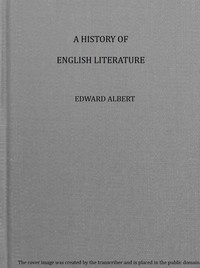
A history of English literature : A practical text-book by Edward Albert

(5 User reviews)   837
By Jason Bauer Posted on Jan 12, 2026
In Category - Comedy Writing
Albert, Edward, 1890-1944 Albert, Edward, 1890-1944
English
Hey, have you ever wanted to understand English literature but felt intimidated by stuffy academic texts? I just read 'A History of English Literature' by Edward Albert, and it's the friendly guide you've been looking for. Forget dry facts and dates. Albert walks you through the story of English writing, from the earliest Anglo-Saxon poems to the novels of the early 20th century, as if he's showing you around a fascinating museum. He connects the writers and their work to the times they lived in, making it all click. It's not just a list of names; it's the 'why' behind the books we still read today. If you've ever been curious about how we got from Beowulf to Virginia Woolf, this is your perfect, practical starting point.
Share

Read "A history of English literature : A practical text-book by Edward Albert" Online

This book is available in the public domain. Start reading the digital edition below.

START READING FULL BOOK
Instant Access    Mobile Friendly

Book Preview

A short preview of the book’s content is shown below to give you an idea of its style and themes.

In the first place the aim has been to make the book comprehensive. All first-class and nearly all second-class authors (so far as such classification is generally accepted) have been included. Due proportion between the two groups has been attempted by giving the more important authors greater space. The complete index should assist in making the book a handy volume of reference as well as a historical sketch. In accordance with the plan of making the volume as comprehensive as possible, a chapter has been added dealing with modern writers. An attempt of this kind has certain obvious drawbacks; but it has at least the double advantage of demonstrating the living nature of our literature, and of setting modern authors to scale against the larger historical background. Secondly, the endeavor has been to make the book practical. Discussion has been avoided; facts, so far as they are known and verifiable, are simply stated; dates are quoted whenever it is possible to do so, and where any doubt exists as to these the general opinion of the best authorities has been taken; there are frequent tabulated summaries to assist the mind and eye; and, lastly, there are the exercises. It would be as easy to overpraise as it is to underestimate the value of the exercises. But in their favor one can at least point out that they enable the student to work out for himself some simple literary and historical problems; that they supply a collection of _obiter dicta_ by famous critics; and that they are a storehouse of many additional extracts. The index to all the extracts in the book should assist the student in locating every quotation from any writer he may have in view. While he has never neglected the practical aspect of his task, the writer of the present work has never been content with a bleak summary of our literary history. It has been his ambition to set out the facts with clearness, vivacity, and some kind of literary elegance. How far he has succeeded the reader must judge. The use of the Bibliography (Appendix II) is strongly urged upon all readers. Such a book as the present cannot avoid being fragmentary and incomplete. The student should therefore pursue his inquiries into the volumes mentioned in the Appendix. Owing to the restrictions of space, the Bibliography is small. But all the books given are of moderate price or easily accessible. Moreover, they have been tested by repeated personal use, and can be recommended with some confidence. There remains to set on record the author’s gratitude to his colleagues and good friends, for their skill and good-nature in revising the manuscript and in making many excellent suggestions. E. A. EDINBURGH CONTENTS CHAPTER PAGE I. THE OLD ENGLISH PERIOD 1 II. THE MIDDLE ENGLISH PERIOD 15 III. THE AGE OF CHAUCER 32 IV. FROM CHAUCER TO SPENSER 57 V. THE AGE OF ELIZABETH 87 VI. THE AGE OF MILTON 159 VII. THE AGE OF DRYDEN 190 VIII. THE AGE OF POPE 231 IX. THE AGE OF TRANSITION 281 X. THE RETURN TO NATURE 362 XI. THE VICTORIAN AGE 451 XII. THE POST-VICTORIAN AGE 518 GENERAL QUESTIONS AND EXERCISES 562 APPENDIX I: GENERAL TABLES 581 APPENDIX II: BIBLIOGRAPHY 591 INDEX TO EXTRACTS 601 GENERAL INDEX 607 ACKNOWLEDGMENTS Permissions to use copyrighted material have been courteously granted by the following American publishers: _Brentano’s, Inc._ for the right to print extracts from the works of Bernard Shaw; _E. P. Dutton & Company_ for Siegfried Sassoon; _Duffield & Company_ for H. G. Wells; _Dodd Mead & Company_ for Rupert Brooke; _Harper...

This is a limited preview. Download the book to read the full content.

Let's be honest, the phrase "history of literature" can make even a book lover's eyes glaze over. Edward Albert's book is different. He doesn't just tell you what happened; he shows you how English writing grew and changed over more than a thousand years.

The Story

Albert starts at the very beginning with the epic poem Beowulf and the influence of the church. He then guides you through the Middle Ages, the Renaissance explosion with Shakespeare and Marlowe, and into the 18th and 19th centuries with novelists like Austen and Dickens. He finishes by looking at the modern shifts in the early 1900s. The "story" here is the evolution of style, theme, and language itself, showing how each era's social and political climate directly shaped its greatest writers.

Why You Should Read It

This book is a revelation because it's genuinely practical, just like the title promises. Albert has a gift for clear explanation. He breaks down complex literary movements into understandable ideas and links authors across time in a way that builds a real narrative. Reading it feels like getting the missing context for every classic novel or poem you've ever enjoyed. You finish a chapter and think, "Oh, that's why Romantic poetry sounds like that," or "So that's what the Victorians were worried about." It turns a vast subject into a coherent, engaging journey.

Final Verdict

This is the perfect book for curious readers, book club enthusiasts, or students who want a readable overview without the academic jargon. It's for anyone who loves stories and wants to understand the bigger story of English literature itself. If you've ever felt a gap in your reading knowledge, Albert's friendly and insightful guide is the best way to fill it.


✅ Usage Rights

This work has been identified as being free of known copyright restrictions. Knowledge should be free and accessible.

William Rivera
3 months ago

This caught my eye instantly and the depth of research presented here is truly commendable. I’d rate this higher if I could.

Michelle Rodriguez
5 months ago

Without a doubt, the author clearly understands the subject matter in depth. I will be reading more from this author.

Thomas King
5 months ago

From start to finish, it creates a vivid world that you simply do not want to leave. I would gladly recommend this to others.

Daniel Torres
4 months ago

If you enjoy this genre, it creates a vivid world that you simply do not want to leave. I’d rate this higher if I could.
Donald Martinez
1 month ago

This immediately felt different because the attention to historical detail adds a layer of realism that is rare. This left a lasting impression on me.

4.5
4.5 out of 5 (5 User reviews )

Add a Review

Your Rating *
There are no comments for this eBook.
You must log in to post a comment.
Log in

Related eBooks