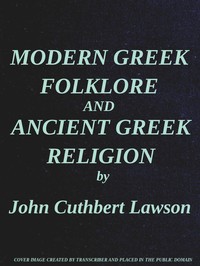
Modern Greek Folklore and Ancient Greek Religion: A Study in Survivals by Lawson

(5 User reviews)   501
By Jason Bauer Posted on Jan 12, 2026
In Category - Comedy Writing
Lawson, J. C. (John Cuthbert), 1874-1935 Lawson, J. C. (John Cuthbert), 1874-1935
English
Ever wonder if ancient myths are truly gone? This book is a detective story about folklore. Lawson, writing over a century ago, argues that the gods of Olympus never really left Greece. He tracks their ghosts, showing how the old beliefs about nymphs, demons, and the evil eye didn't disappear with Christianity. Instead, they went into hiding, changing their names and blending into village stories and daily superstitions. It's a fascinating look at how the past clings on in the most unexpected places, asking us to see the ancient world not as a dead civilization, but as a quiet, persistent whisper in the modern one.
Share

Read "Modern Greek Folklore and Ancient Greek Religion: A Study in Survivals by Lawson" Online

This book is available in the public domain. Start reading the digital edition below.

START READING FULL BOOK
Instant Access    Mobile Friendly

Book Preview

A short preview of the book’s content is shown below to give you an idea of its style and themes.

imprecations suggest luridly novel conceptions of the future life. Much also may be effected by playing upon patriotism or vanity or, let it be confessed, love of lucre. You relate some story heard in a neighbouring village or praise some custom there observed, and the peasant’s parochial patriotism is up in arms to prove the superiority of his native hamlet. You show perhaps some signs of incredulity (but not until your informant is well launched upon his panegyric), and his wounded pride bids him call in his neighbours to corroborate his story. Or again you may hint at a little largesse, not of course for your host--only witches and the professional reciters of folk-tales and ballads are entitled to a fee--but on behalf of his children, and he may pardon and satisfy what might otherwise have seemed too inquisitive a curiosity. Such are the folk to whom I am most beholden, and how shall I fitly acknowledge my debt to them? Their very names maybe were unknown to me even then, or at the most a ‘John’ or ‘George’ sufficed; and they in turn knew not that I was in their debt. You, muleteers and boatmen, who drove shrewd bargains for your services and gave unwittingly so much beside, and you too, cottagers, who gave a night’s lodging to a stranger and never guessed that your chatter was more prized than your shelter, how shall I thank you? Not severally, for I cannot write nor could you ever read the list of acknowledgements due; but to you all, Georges and Johns, Demetris and Constantines, and rare anachronistic Epaminondases, in memory of services rendered unawares, greeting from afar and true gratitude! Nor must I omit to mention the assistance which I have derived from written sources. In recent times it has been a favourite amusement with Greeks of some education to compile little histories of the particular district or island in which they live, and many of these contain a chapter devoted to the customs and superstitions of the locality. From these, as also from the records of travel in Greece, particularly those of French writers of the seventeenth and eighteenth centuries, I have culled much that is valuable. Nearly ten years have passed since my return from Greece, and such leisure as they have allowed has been devoted to co-ordinating the piecemeal information which I personally obtained or have gathered from the writings of others, and to examining its bearing upon the life and thought of Ancient Greece. In the former half of this task I have but followed in the steps of Bernhard Schmidt and of Polites, who had already presented a coherent, if still incomplete, account of the folklore of Modern Greece, and my work has been mainly to check, to correct, and to amplify; but for the latter half I would ask the indulgent consideration which may fairly be extended to a pioneer. Analogies and coincidences in the beliefs and customs of modern and of ancient Greece have indeed been pointed out by others; but no large attempt has previously been made to trace the continuity of the life and thought of the Greek people, and to exhibit modern Greek folklore as an essential factor in the interpretation of ancient Greek religion. It is my hope that this book will prove interesting not to Greek scholars only, but to readers who have little or no acquaintance with Greek. All quotations whether from the ancient or modern language are translated, and references to ancient and modern writers are distinguished by the use of the ordinary Latinised names and...

This is a limited preview. Download the book to read the full content.

Let's be clear: this isn't a novel. There's no main character, unless you count Greece itself. Written in 1910, the book is Lawson's attempt to prove a bold idea. He believed the ancient Greek religion, the world of Zeus and Pan, didn't just vanish when Christianity arrived. Instead, its pieces survived, hidden in plain sight within the folk tales, superstitions, and village customs of early 20th-century Greece.

The Story

Think of it as an intellectual scavenger hunt. Lawson travels through rural Greece, listening to stories. He hears about the Neraïdes, beautiful but dangerous spirits of the wild. To him, they're the direct descendants of the ancient nymphs. He examines the widespread fear of the evil eye and sees echoes of old curse tablets. The book systematically connects these modern beliefs back to their ancient roots, showing a continuous thread of thought running for thousands of years.

Why You Should Read It

What grabbed me was the sense of discovery. It makes you look at stories differently. Lawson shows that culture isn't something we easily shed; it adapts. A god becomes a saint, a nymph becomes a fairy, but the core fear or wonder remains. Reading it feels like pulling back a curtain on history, seeing the ancient world not in ruins, but alive in the habits of everyday people.

Final Verdict

This is a classic for a reason. It's perfect for anyone who loves mythology, history, or cultural anthropology. Be warned, it's an old academic text, so the language can be dense in places. But if you're patient, it offers a truly unique perspective. You won't just learn about ancient Greece; you'll start seeing its fingerprints everywhere.


🔓 Copyright Status

You are viewing a work that belongs to the global public domain. It is available for public use and education.

Patricia Brown
1 month ago

I didn’t realize how engaging this would be until it manages to explain difficult concepts in plain English. Truly inspiring.

Donald Flores
2 months ago

I was pleasantly surprised because it challenges the reader's perspective in the most intellectual way. I'm sending the link to all my friends.

Donald Hall
4 months ago

This caught my eye instantly and the interplay between the protagonists drives the story forward beautifully. Well worth recommending.

Deborah Perez
2 months ago

I approached this with curiosity because the atmosphere created by the descriptive language is totally immersive. I learned so much from this.

Charles Williams
5 months ago

Surprisingly enough, the content encourages further exploration of the subject. It is definitely a 5-star read from me.

4.5
4.5 out of 5 (5 User reviews )

Add a Review

Your Rating *
There are no comments for this eBook.
You must log in to post a comment.
Log in

Related eBooks