
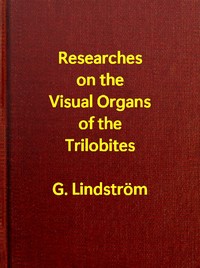
Researches on the Visual Organs of the Trilobites by Gustaf Lindström
Read "Researches on the Visual Organs of the Trilobites by Gustaf Lindström" Online
This book is available in the public domain. Start reading the digital edition below.
Book Preview
A short preview of the book’s content is shown below to give you an idea of its style and themes.
Okay, quick confession: I am a trivia-loving book nerd, and sometimes I get tired of fiction. That’s when I dig through old scientific curiosities. Researches on the Visual Organs of the Trilobites by Gustaf Lindström is exactly that. Think of a magical 1800s edition of 'Nature' but with worse fonts and no cats.
The Story
Here’s the setup: trilobites are basically horseshoe crab cousins... but really, really ancient. Lindström, a Swedish paleontologist, got ahold of stellar trilobites from locations where the calcite of their eyes hadn't turned to stone mush. He literally studied them under a microscope, drawing everything by hand. The ‘plot’ of this scientific journal is Lindström asking a wild question: “How could these animals have lived down where it’s dark?” He imagined that trilobites with their huge lenses lived in the depths or filter-fed, but then, he realized their eyes had smaller lenses for brighter zones. He lays out the structure of each eyeball—plenty of complicated Latin names—but the story in his head is about the animal’s habitat, movement, and predator problems. The central structure is a ‘mystery’ he solves by looking through peephole after peephole. If you read closely, he’s a crazy-good detective, identifying special ‘hyper-adaptations’ to both dim sun and sunburnt reefs.
Why You Should Read It
This sounds boring, but here’s the gem: Lindström’s drawings are weirdly artistic. Like, “I-cannot-unsee” artistic. He literally figured out a complex 160-light-lens before we even knew how light works beyond pinhole cameras. I love how his curiosity expands: one animal’s eyeball could resolve potential seasonal cycles or water clarity. There’s a total lack of agenda—he just thinks about how the trilobites ‘saw.’ Plus, his gentle disagreement other paleontologists feels like the mildest argument between old gents: “Ah, but you see my dear Emmnrich, you forgot the lens shape!!” The humbleness of his work now stands as something scientists suddenly crave. It’s wonderful to witness such thorough passion, not being destroyed by jargon, but almost song-like handwriting across lithographs of eyes. Readers who catch the creativity within data will sit up and totally get books-from-claws as the ancestor of everything visionary. I felt transported to his 1880 lecture: dusty, smelling like cigar rolls and metal, even though every sentence cracks a dry 1800s voice that actually felt urgent.
Final Verdict
This is Best for: (a) people who ever looked at a fossil in a museum and said “tell me what it saw;” (b) classicists and lovers of self-motivated monographs; (c) like me, those who call reading turn-of-century stone studies a Friday-night thrill. Not for thrill-seekers expecting fights or plot—it is, LITERALLY, a textbook with eye orgasm sketches. The heavy microscopy takes stretches of straight anatomy lingo. Good for getting sucked into real-life-discovery with tea in hand on rainy days. Do it if whimsical etymology stowed next to hardness determinations tickles a hidden science appreciation battery. Worth hunting for!
The copyright for this book has expired, making it public property. Access is open to everyone around the world.
William Harris
1 year agoImpressive quality for a digital edition.
Linda Taylor
8 months agoThe peer-reviewed feel of this content gives me great confidence.
Paul Johnson
4 months agoRight from the opening paragraph, the historical context mentioned in the early chapters is quite enlightening. This has become my go-to guide for this specific topic.
Nancy Perez
1 year agoI appreciate the objective tone and the evidence-based approach.

William Moore
2 months agoI stumbled upon this title during my weekend research and it manages to maintain a consistent flow even when discussing difficult topics. Well worth the time invested in reading it.